
Bask watches the temperature and humidity in every enclosure and shows one simple answer from across the room: a big green “all good,” or a red alert that tells you exactly what’s wrong.
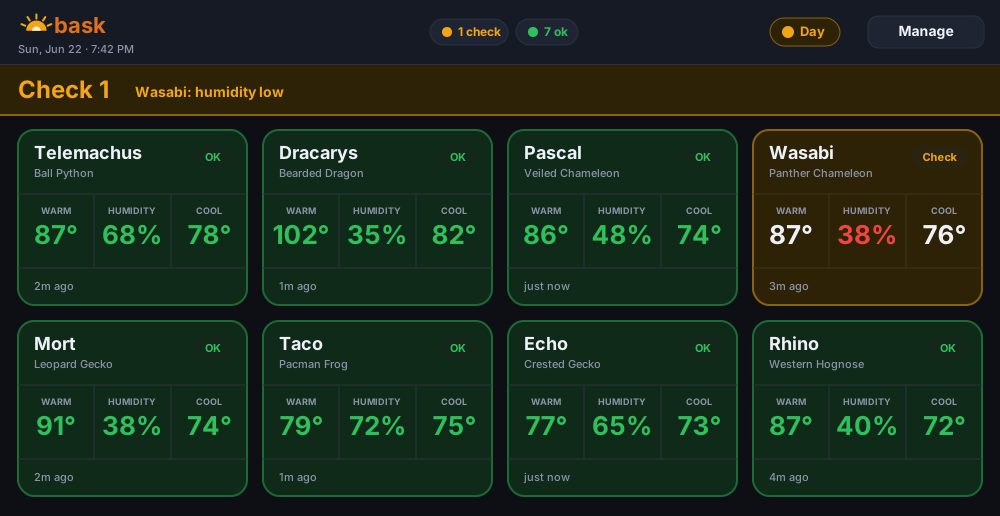
Bask reads the same affordable Govee sensors many keepers already use, and turns them into a calm, at-a-glance wall display.
A giant green “all good,” or a red banner naming the out-of-range enclosure and exactly which reading is off.
Set the right warm-side, cool-side, and humidity targets per species. Ships with sensible starting points for common reptiles.
Different targets for lights-on and lights-off, switched automatically — so a normal night-time drop doesn’t cry wolf.
Reads your Govee sensors over Bluetooth. No pairing dance, no Govee account, no wires across the room.
Warns you before a sensor’s battery dies or drops off — so you’re never blind without knowing it.
Optional phone alerts the moment an enclosure needs attention — even when you’re away from home. Two-minute setup.
Add it to your phone or tablet’s home screen — its own icon, opens fullscreen. No app store needed.
Runs on a tiny computer in your home, with no vendor account to sign up for. Monitoring sends nothing out; optional extras like phone alerts reach only the service you pick. No subscription, ever.
A one-time setup with inexpensive, easy-to-find parts. No soldering, no wiring.
Any supported 64-bit model running Raspberry Pi OS — use the SD card that came with it if it already boots. Bask runs in about 130 MB, so 512 MB is enough and even a Pi Zero 2 W is comfortable. A Pi 4 is the easy pick if you may add Shed later, which wants 1 GB of its own.
One small thermo-hygrometer in each enclosure you want to watch. Affordable and widely available.
View it on your phone, a tablet, an old monitor, or a smart display — anything with a web browser on your Wi-Fi.
If your Pi already starts Raspberry Pi OS, keep its SD card. Open Terminal, paste one installer command, and Bask handles Docker, Bluetooth, storage, and automatic startup.
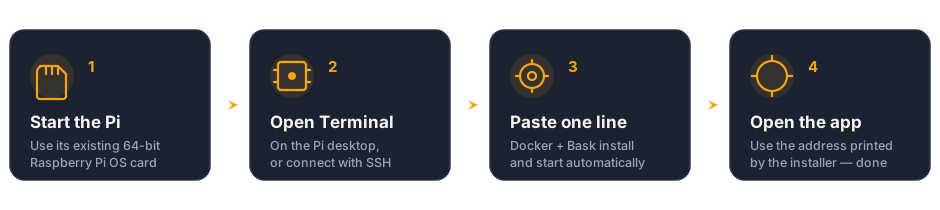
Use the working OS card that came with your Pi, or install Raspberry Pi OS (64-bit) with Raspberry Pi Imager. Connect the Pi to your home network.
Use Terminal directly on the Pi desktop, or enable SSH and connect from another computer. No Linux or Docker knowledge is needed.
The installer prepares Docker and Bluetooth, downloads the prebuilt Bask image, and sets it to start automatically on every boot. Nothing is compiled on the Pi, so this is a download rather than a long wait.
The installer finishes by printing the address, a numeric one like http://192.168.1.50:8080. Open that on any device on your Wi-Fi, tap ⚙ Manage → Pair by proximity, hold a Govee sensor near the Pi, and assign it to an enclosure. Done!
The installer also offers a .local name as an alternative. It is easier to remember, but it only works on devices that support mDNS — which Windows without Bonjour, and a good many Android phones, do not. If it will not load, use the numeric address.
curl -fsSL https://animalroom.app/bask/install.sh | bash
Run the same command later to update Bask without replacing your settings or sensor history.
Want care schedules too? Choose Haven in the Haven installer to set up Bask + Shed and automatically connect their combined room dashboard.
Yes — completely free and open-source under the MIT license. There’s no account, no subscription, and nothing is sold. If it helps and you’d like to chip in toward the animals’ crickets, there’s an optional tip jar, but it’s never required.
No. Start Raspberry Pi OS, open Terminal, and paste one line. The installer handles Docker, Bluetooth, persistent storage, and automatic startup. The beginner guide explains both the on-screen and remote-SSH routes.
Bask works for any keeper using Govee H5075 sensors. It ships with starting temperature and humidity ranges for several common reptiles, and you can adjust every number to match your species and your room. It’s a monitoring aid, not veterinary advice — always verify against trusted care resources.
Yes. Sensor readings, enclosure settings, and history stay on your own Raspberry Pi. Core monitoring needs no account or cloud. Optional integrations such as ntfy alerts or Cielo room climate contact only the service you choose to connect.
Run the same one-line installer again. It downloads the current prebuilt image and restarts Bask on it, without replacing your settings or history. Nothing is compiled on your Pi, so an update is a download rather than a long rebuild. The Settings screen also provides a portable backup download.
Two things cause almost all of these. First, the address: use the numeric one the installer printed, like http://192.168.1.50:8080. A .local address only works on devices that support it, which Windows and many Android phones do not. Second, memory — if the board ran out while starting, the app is killed and the address simply refuses to load.
This reports both, plus anything else useful, and you can paste the result to whoever is helping:
curl -fsSL https://animalroom.app/doctor.sh | bash
It only reads your system and changes nothing. It contains no records, passwords, or access codes — settings are listed by name only, never by value.
Yes. Open it on a cheap wall-mounted tablet, an old phone, a monitor, or a smart display like an Amazon Echo Show — anything with a web browser on your network.